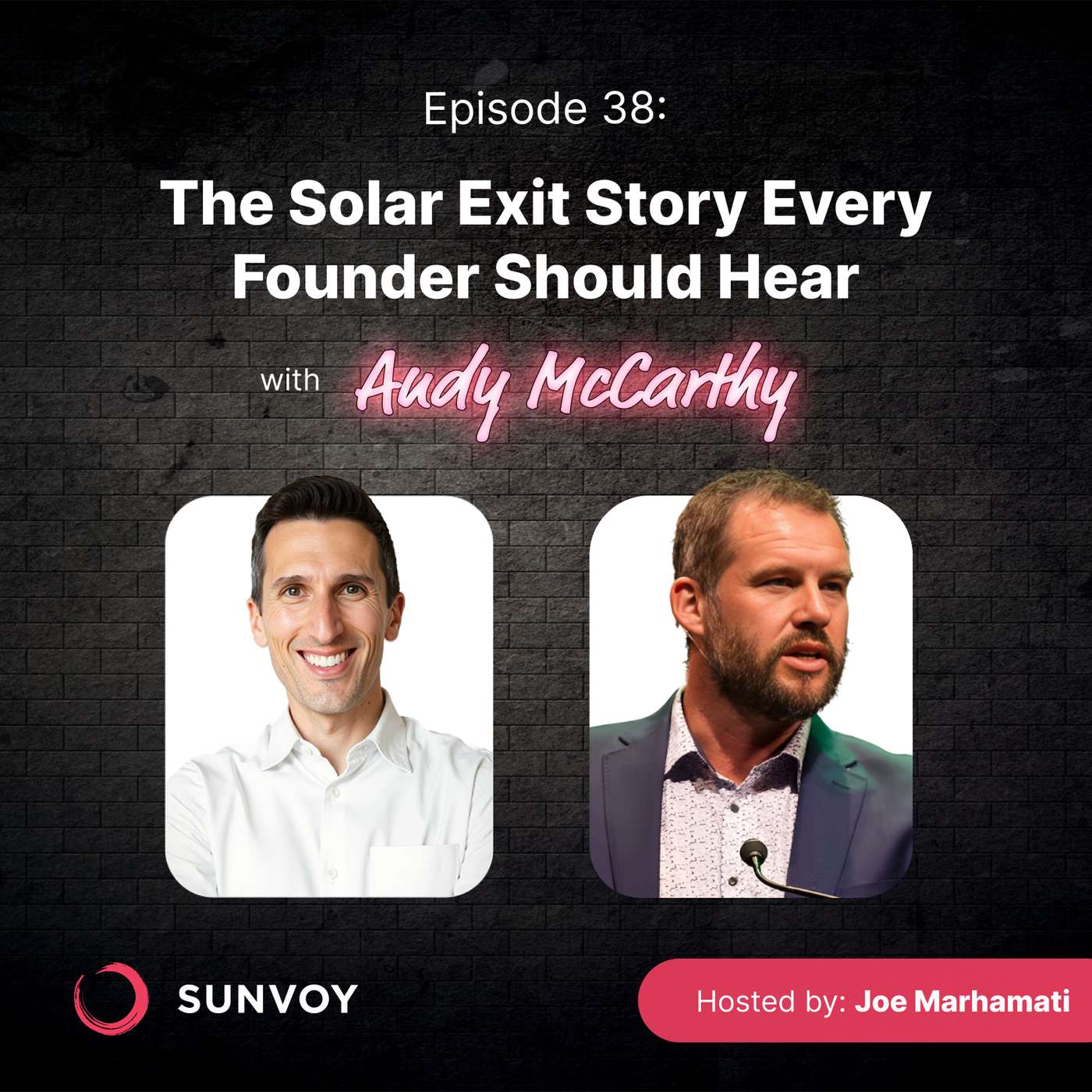
Ver todos los episodiosEP 38
The Solar Exit Story Every Founder Should Hear
Sobre este episodio
Andy McCarthy went from building a solar company in his garage to successfully exiting and he shares the real story behind that journey. In this episode, he breaks down the Australian solar market, the policy headwinds installers have to navigate, and what it actually takes to build something worth selling. It’s a grounded look at growth, grit, and where renewable energy is heading next.
Transcripción
Joe Marhamati (00:00)
Welcome, everyone, to the latest edition of What Solar Installers Need to Know, brought to you by Sunvoy today. I'm honored to have Andy McCarthy, the founder and CEO of Gippsland Solar, who built and sold a solar business. If that sounds familiar to you, Andy and I have a lot to talk about today from his days building a solar company in his garage, getting on a lot of roofs and eventually selling his solar business, writing.
a book about it called Here Comes the Sun, and eventually starting his own consulting firm. Welcome, Andy, to the show.
Andy McCarthy (00:33)
Thank you, Joe. Pleasure to be here.
Joe Marhamati (00:34)
I'm so excited for this conversation. My biggest concern is can we keep it to one hour? Because I don't think I've ever had anyone on this show that I have more in common with than you. There's very few people out there who have built a solar business from the ground up, from zero, from their garage, and then sold it and moved on to help other solar entrepreneurs and then written a book about it. I haven't written a book about it, but we have a blog. So I'm so excited to hear your story
from you, what got you into the solar industry in the first place?
Andy McCarthy (01:04)
Well, I was quite a troubled child, to be honest with you, Joe. I found myself at 15 having been in trouble at school, in trouble with the law, kicked out of home. I was just a really unsettled child. I didn't realize at the time, but I was just suffering from sort of raging ADHD, very neurodivergent, neuro spicy, I think as you've referred to it. And I just had this...
fierce amount of energy burning with inside me and I just didn't know how to direct it. So I just chose to cause trouble. And the first 15 years of my life were, you know, really sending me on the wrong path and probably a little bit concerned about where I was heading, I suppose in hindsight. So I left school at 15, left before I was kicked out. And in the end I went and worked about 30 jobs, I think between 15 and 19.
Somehow found myself working for a deep cycle battery company. And then one day a customer came in to our showroom and asked me if there was an easier way to charge his battery. This is 2001 mind you. So the idea of using solar panels to power batteries was not really apparent in Australia at the time. Did some research and found out I could buy an 80 watt solar panel online. And then I bought it for $800 and sold it for 1200 and helped them install it. And I thought, oh, that was pretty good margin, a bit of money.
I found something I can get passionate about. I went out into the field and helped him install and kicked it into the little charge regulator. And then as soon as those red and blue lights lit up on the controller, was just like something lit up inside me. I just, from that moment on, it was quite visceral and quite instant where I just knew that this was my purpose and my mission for the last 25 years, I've just been ruthlessly committed to this energy transition that still drives me today.
Joe Marhamati (02:40)
That's awesome. And was there any other inspiration to get you into the, you know, the environmental movement or climate tech? Was there a movie or a book or an individual, or was it really just like, you saw this opportunity in the market that was un-minted and just raining.
Andy McCarthy (02:57)
Yeah, that's pretty much it. I wouldn't pretend to have an environmental bone in my body back in 2001 if I'm being honest. I was reflecting on this when I wrote the book about whether I had some sort of a higher purpose for sustainability or environmentalism and I was scratching around and I couldn't find anything that was a driver for that at that stage in my life. I'll be perfectly frank.
I think maybe that's why I might've enjoyed success along the way. Like I became so passionate about this mission and this purpose. But I think I also came to it from a lens of, just loved the idea of running my own business. I was so entrepreneurial. I had my first business when I was 11, selling scones in my local neighborhood and making them with fresh jam and cream and wrapping them up in foil. then I started knowing lawns and all I wanted to do was run a business. And I found a way to combine my love for business with something that fired up
a higher purpose in me and that's how I discovered renewables and I'm absolutely passionate about the environmental component and the why we do what we do now but it wasn't something that drove me at the time.
Joe Marhamati (03:56)
How did you go from that one project to well over 150 people? Because I could say in eight years I was running our business, we got to 50, 60 people and I found that to be challenging once you get to middle managers and layers and HR. I can't even imagine getting to over 150. Tell us a little bit about that journey and that scale.
Andy McCarthy (04:17)
Yeah, and there's a lot of similarities there as well because I reflect on the good old days of our business journey in the parts that I loved the most. And it was before we got too big, I think it's fair to say. So I worked for a number of companies in Melbourne in the capital of Victoria ⁓ over 10 years. And then I moved out to coal country and chasing love, married the love of my life. And she took me out to her home region of Gippsland in Victoria, which I think
coal-fired power stations, I think at that time were the third largest employer in the region. So they dominated the landscape, the economy and the conversation down here. And so when I couldn't find a job down here because there were no solar companies in 2010, I came home I think I've applied to every solar company down here looking for a job, which I think there was about four. And I couldn't find a job and...
Kel was seven or eight months pregnant at the time and had just quit her job and we were heavily capital constrained and nothing, no money behind us and just moved to a town where we didn't know anyone. And then Kel turned around and said, well, if there's no jobs, then there's no competition. So maybe we should start our own solar business. That was all the inspiration I needed. Joe, I was off and away, built a little office in my garage in the third bedroom of our family home in a little town called Mirboo North, population 2000 people.
And I just hustled and hustled for years. was working, you know, the old 17, 18 hour days, I would get up and do all the paperwork and load the trailers for the electricians before the kids got up in the morning, put them to bed at night and do all my inversing and paperwork. I was on the roof myself working with the installers, physically installing our first, you know, 100 or 200 systems. And there was times where I nearly gave up over the first few years and...
in cold country when everyone hates you and everything you stand for back in 2010, it was hard to see a way through. And there were times where I thought that maybe I was crazy. Maybe there's a reason why no one's done this yet. It's because it's just not going to work. I consider myself a very driven person, but I was drowning in self doubt thereafter the first year or two. So I had to push through that with support of my beautiful wife, Kelly, and also some amazing mentors around me,
and just had to back myself in and say, I'm gonna go and die on this hill and I'm gonna go down swinging. And then eventually the conversation sort of shifted as coal fire power stations started closing. The narrative started to turn and also renewable energy became cheaper than buying energy from the grid and from coal fire power stations. So after those first few years, we employed our first staff member maybe three or four years into our journey. We opened a little shop in the main street of our little town of 2000 people and
we sold out to most of the people in our hometown. Then we opened another showroom in the middle of the Latrobe Valley, right under the chimney stacks of the Coldfire power stations. And you think that didn't invite some scorn and ridicule from people, but we believed so strongly at that point in what we could achieve. By that stage in 2015, the force of my own self-belief was stronger than the force of people around me telling me it wasn't possible. And from that on, I never doubted we'd make it a success. And I'm really
proud of the people we put around us and the journey that we went on together.
Joe Marhamati (07:12)
So I read in a Guardian article from a couple of years ago about people spitting on you in your town, about people being so anti-solar because they viewed the legacy of their family and their children as working in one industry, in the fossil fuel industry. What is that culture like today? I presume that it's evolved. And how do people view solar relative to this kind of legacy industry in the same part of the world today?
Andy McCarthy (07:38)
Yeah, it's been an interesting journey. I mean, prior to people spitting on me, there wasn't even an anger or a hostility. It was really more like ridicule. You know, in Australia, we have a saying, first they laugh at you and then they fight you and then you win. And I'm not sure if you have that in the US, but that's kind of what it was like. Like people just, people like openly smirked at me and ridiculed our vision for a renewable energy future down here.
Back then about 0.1% of homes had solar panels on the roof in the Latrobe Valley. Now it's about 40%. And it was twice the price of buying electricity from the grid from coal-fired power stations. Most of the people I knew or their family members were working in the coal-fired power sector or in the connected businesses that were feeding that industry. And so I talked about this vision of solar panels on roofs,
feeding batteries on homes, powering electric vehicles that would become our transportation and people like this guy's off his head. And it sounded crazy to people because they had never had anyone pushing this belief with such conviction. So then we started to enjoy some success. And then I remember distinctly the first day that we put a 100 kilowatt system on the roof of the La Trobe City Council, which is the council in the La Trobe Valley here,
and the anger and the vitriol that people had towards the council for encouraging solar and in their eyes putting their community out of work. I just remember thinking, how do people not see that this can be a wonderful thing for the future, that we can have the jobs of today and then creating the jobs of tomorrow at the same time? I just didn't understand. And maybe in hindsight, I've reflected on this in the book, is that maybe I had my head up my own backside, like
I was so driven and so bloody minded about energy transition that I couldn't really see it from other people's perspective. And so I had some pretty strong minded people around me who pulled me up and let me know that I was really, my approach was all wrong. And so the minute that I stopped and thought about other people's perspective and how to meet them when they were, that's the moment that we enjoyed true success and
from then on, actually became quite angry about some of the green groups, you have to understand that this is everything that they've ever known and they can't see a future that this won't be a part of it. So it's a scary thing and you have to treat people with respect and courtesy if you want them to buy into your vision. And that's what I think we managed to do and maybe why the business was so successful.
Joe Marhamati (09:53)
Well, clearly if you're talking about 40% of people having solar, that from the perspective of an American is almost inconceivable. I remember the first time probably about 10 years ago when we started our solar business, I read an article, I think it was in GTM media, one of the main outlets here in the US that showed a diagram of going solar in the US versus going solar in Australia. And you know, in the US it's like 10 different decision trees and
a thousand layers and it really is like that. And then in Australia it was like two boxes, you know, it like you fill out this form and then you install the solar and it absolutely blew my mind because I just didn't know what going solar was like in any other country. I assumed it was the same everywhere, but it turns out the United States is the only one. Now, of course, Australia has what more than a third of people have solar in Australia, which is absolutely mind-boggling to me. What is going on down in
that makes it so easy to go solar. And what about the pros? And I'm sure there are a few cons. But what do you think is the difference in the culture of going solar that it's made it so much easier?
Andy McCarthy (11:01)
Well, I'm glad that you mentioned the pros and the cons because that is something that I think gets lost in this whole conversation. Like I've done podcasts with people in maybe half a dozen countries now, a few in the US and New Zealand and Europe and Asia. And everyone's quick to paint Australia as being some postcard from the future and some bastion of success that the whole world can learn from. But we have made so many mistakes when you look beyond that high level number and you think what a wonderful story Australia is.
The saddest thing about it is that we might have about three and half or nearly four million solar systems installed on rooftops in Australia, and a population of 25 million or thereabouts. But of the four million systems that are installed, over 1.5 million of those have been installed by a company that's no longer in business. And there's a number of things that have affected that, but largely it's just a byproduct of us being so generous with our incentives and our upfront rebates to install solar.
You know, the thing that amazes people in the US is that you can put a 10 kilowatt system on your roof in Australia for about 4,000 Australian dollars, about 3,000 US or whatever it is. So yeah, it's wonderful that we've deployed so much solar and rooftops around the country. And some states in Australia are actually generating 100% of their entire state's energy needs just rooftop solar at certain times in spring and autumn. Incredible at a high level, but if you go down several levels and look at the actual
machinations and the inner workings of our industry, there's been a lot of collateral damage along the way. And we've made a lot of mistakes with what we call the solar coaster, the ups and downs that we've brought in through government policy. And I was really pleased when I did the keynote at the New Zealand Solar Conference last year. And they said as an industry that we're committed to no upfront incentives and rebates because we've seen what happened in Australia and we don't want to emulate that. We want to do it methodically and sustainably
and I would encourage other countries to think along the same lines.
Joe Marhamati (12:50)
So what would have been the biggest downsides? And I'll say in the US, it's not too dissimilar. There's a lot of these orphan systems that, you know, the fly-by-night companies installed them, maybe even electricians that weren't particularly trained in solar, maybe door knockers who were misleading folks. So we have similar types of problems in the US. The difference is people got charged $50,000 for that 10 kilowatt system or $70,000
not $3,000, which is hard to comprehend. So is it just that a lot of these systems were poor quality, they weren't inspected properly, or is it that they were installed fine, but that there's just no one that's there to maintain those systems today?
Andy McCarthy (13:31)
Well, I would say it was D, all of the above. mean, if you reverse engineer it, even so when I say $3,000 installed for a 10 kilowatt system, there was also maybe a $3,000 government rebate built into that. So let's call it $6,000 for a 10 kilowatt system or maybe seven or eight at the most. In order to target that price and to be able to do that and still be able to keep the bills paid, you have to use the cheapest quality product that is coming into Australia with varying levels of
quality and efficiency. You have to find installers that are prepared to work for four or five hundred dollars a day, including an apprentice and materials. And in order for them to do a job at that price, they then have to install two or three systems a day, leave the apprentice to finish off the installation, even though you've signed off as being there and rush to the next job. There's a number of ways where the race to the bottom has ended up affecting the end product.
And it's really sad because as much as I wanted to see solar coming down in price and mass adoption taking off, which we have seen, there was a way that we could have done that without going to the depths that didn't have to be that cheap for people to take it up. Like if it was 70 cents a watt, $7,000 for a 10 kilowatt system in Australia, with our price of electricity during the day,
it still would have had a four or four and a half year return on investment, which for most people is entirely satisfactory. So we've gone way too hard to make it politically popular, I think in a lot of ways to get more people to install solar and to be able to tell that story. And so look what we've done with our policies. But the reality is people like my parents and your parents out there who have installed a system because it seemed like a great deal. The company's gone broke
you know, try calling a solar company and saying, need you to come and have a look at this system and fix it for me. And then they say that we install it. You say, no, you didn't. I say, well, no worries. We're really busy. We'll get back to you. They're not interested. So it's really sad, but I think that there has been a lot of great successes and we've definitely learned over the last few years how to implement smart policy and with the solar battery rebate that we have in place now, there's a lot more checks and balances and the quality of delivery is actually a lot higher.
Joe Marhamati (15:37)
That's really great to hear. Tell me how Gippsland Solar distinguished themselves, differentiated itself from the competition. Were you kind of part of this cheaper solar movement or were you trying to differentiate yourself in terms of quality or equipment? What was the main differentiator?
Andy McCarthy (15:37)
Thanks
I think we were one of the first companies to identify that there is a minimum price you have to pay for a quality product installed by quality company with support whenever you need it in the future. I mean, I really played off the fact that I live in a town of 2000 people. The one thing that every country has in common, I'm sure it's the same in the US, is that if you are the trusted local person in your region, that is the best marketing angle that you could possibly have.
Our first marketing campaign, the Gippsland Solar, when we were trying to grow back in 2013, was that we are the local alternative to the big solar companies. So I would front the ad as Andy from Gippsland Solar. You're not calling Gippsland Solar, you're calling Andy. And you can trust me, because I live in a town of 2000 people with one street, and if I do the wrong thing by you and I don't answer your call when you've got a problem, I'm gonna be coaching your kids at the local footy,
or I'm going to see you at the supermarket or our kids will be going to school together. There is no way for me to avoid you and I can't be anonymous. And that just like it sounds obvious, I think in a lot of companies work off that, but it just really landed at the time because we would say we were always going to be more expensive. But if you call us, we look after you and we're good for our word and that will actually cost you less than the
Joe Marhamati (17:01)
Yeah, it reminds me of the ethos that we had in my solar business. It was the same thing. And it's hard. We built a business in the Washington, DC area where there was probably already 50 solar businesses even in 2016 when we started. And so it was a different kind of argument because there's 8 million people living in the greater area. And when there's so much competition, there's always going to be someone cheaper than you. And when your competitor is saying,
well, there's no moving parts and there's no maintenance and it just runs on its own for 30 years. And, you know, we have a lifetime warranty until you die. It's kind of hard to compete with that. Right. So, but we, actually have this great group here in America and Thursday, I have something in Australia called the Amicus solar cooperative, which is a group of B corps and mission driven companies, employee owned companies that do charge more on Enbridge than a lot of the other solar companies, but do great work because they're locally owned and operated businesses.
Has there been any similar kind of movement in Australia of kind of employee owned businesses, locally owned solar businesses getting together in a buying cooperative or anything to kind of get some trade secrets and get CEOs talking to each other or anything like that propped up?
Andy McCarthy (18:11)
We don't sort of have it in a sense of a buying group or economy of scale purchasing power, but we do have some great affiliations in this industry that have started really organically. For the Simpsons fans out there who'd be familiar with the Stone Cutters on the Simpsons, two of my good friends started an organization called the Solar Cutters. so it started off over a few beers, maybe an espresso martini one night at a bar. And we said, like, what if there was a way to bring together a bunch of light,
who have the same challenges, who might compete very infrequently, but have more in common than what separates them. And if we were to start a networking group where we get together, we share our challenges, we open up, and then all of these businesses just started to lift up through their shared knowledge and shared strains and successes. And it became this incredible movement. The first event, I think we had 300 people turn up at networking event.
And then one of the manufacturers sponsored the next one the next year and we had 700 people turn up and we took over an entire bar at the casino near a conference that we had here. And before you knew it, this whole thing just took off and everyone that became part of that movement just became better through that shared experience. even somewhere you can come and get a bit of free counseling and just get some things off your chest and often find that the people you're talking to are dealing with the same thing. So
it was beautiful in the way that it started organically and then it became quite a powerful movement with a lot of influence within the industry over a few years.
Joe Marhamati (19:33)
That's awesome. Yeah, I think really that's the way to go is getting like minded executives together to just share what works, what doesn't work. I gained so much from that. I don't think my solar business would have made it through to the finish line if we didn't have other people like that just to shoulder to cry on sometimes or someone to call you asking a question. I think the thing that the amicus did really well is it started as a buying cooperative. So you had
tons of buying power for 50, 100 companies so they really could compete against the national installers. Does Australia have big box, you know, coast to coast national installers that you were competing against?
Andy McCarthy (20:11)
Yeah, there's, we have what we call a very long tail in this industry. So there's probably half a dozen companies that have a significant amount of the market share in Australia. I'd probably, let's say off the top of my head, maybe 60%, 70% of the market share between those few companies. And they've managed to scale. Some of them do a great job. Some of them just purely compete on driving the price down, screwing the supply chain and finding the cheapest installation partners they can.
Some of them have phoenixed and started up as very similar sounding names with similar looking boards of directors and that sort of thing, which happens in every industry. But then we have a lot of this long tail, like these guys and girls in these small regional communities like mine, where a lot of the time the customers don't get a second quote. They know that you employ three apprentices in your town. You have a sign on the fence at the local sporting club
you invest in the community in so many different ways. Our business, we put a percentage of everything that we made in revenue back into the Gippsland Solar Community Fund. And we would donate solar systems to wildlife shelters or domestic violence centres or organisations that were doing amazing work and struggling with their electricity bills. We would come together and say, we're trying to build this fund,
and of which a percentage goes back into doing this work that we're extremely passionate about. So everyone can see that every dollar they invested with us went back into the community in some form. And I think that becomes really powerful and it ring fences you around your market, in a way that I think is very hard to overcome for the big companies that roll into town with this scale behind them.
Joe Marhamati (21:40)
And so now let's talk about how our career really intersected, our stories intersected. I'm so curious to know what motivated you to eventually sell the business, what that process was like of finding a buyer that was aligned with your values, that would respect your mission and your team, and then also what that transition has been like for you.
Andy McCarthy (21:43)
Thank you.
Well, the hour could start now because there's a lot in that, Joe, as I'm sure you can relate. Look, I would love to give you this beautiful polished version of how I built this business up with an eye to managing a strategic acquisition and securing an exit and blah, blah, blah. The reality was I had a mental breakdown in 2018. I'm very open about that. And that is the reason why I wrote the book.
Joe Marhamati (22:03)
Hahaha!
Andy McCarthy (22:21)
The downside of this drive and this passion that I had that just overcame everything else in my life was that for 10 years, all I ever wanted to do was run the biggest balling solar and battery business in the country and just change the world. Like, I loved it. I got out of bed, it was the first thing I thought about in the morning or last thing at night. And I couldn't sleep because I had ideas. So I'd go and jot them down. I loved it. But
I neglected my family, I neglected my health, I neglected my friends and my exercise and diet. And I didn't want to do anything else but run this business which I managed to achieve. But then the first time that I actually felt like I could take a break once I had a good management team around me and we'd done a lot of the fun parts of growing. And I think we were maybe doing, I don't know, 20 or 30 million dollars a year in revenue by that stage. And we're quite sustainable.
So I gave myself a head space to go and take a month off with the family. started at the InterSolar Conference in Munich and then continued on for a family holiday. And then the last night of the holidays, I was working a game of soccer and then the final whistle went and it was like as soon as that whistle went, it kind of pierced my consciousness and immediately I was shot out of this sort of holiday mindset to the things I had to deal with when I got home and all of the employee issues I was dealing with and suppliers and customers that were causing me a bit of grief.
And then that realization that I had to go back and get back on the horse, it just triggered some kind of a complete and utter mental and physical breakdown. I ended up on my hands and knees on the hardwood floor at one o'clock in the morning in Barcelona, where I believe you live these days. And I was just pouring out with sweat. I was shaking like a leaf. It was violent and terrifying. And I ended up just getting up and throwing my sneakers on and just running the streets of Barcelona at one o'clock in the morning,
collapsed in a heap. And then I got back to Australia in peak winter in 2018 and started having these panic attacks every two or three times a week and then every night and then before breakfast. I was on the phone to the Beyond Blue Hotline, the mental health hotline, sometimes three or four times a day because I just fell apart. So it's a big part of my journey is telling people here on paper we enjoy great success and
It was kind of interesting because the times where I was having these meltdowns at two o'clock in the morning, running around my golf course in tears and just vomiting and all these. And then I'd wake up at eight o'clock in the morning to a message on LinkedIn from someone pouring their heart out about how incredible our success story was and how unbelievable our journey was. And for all intents and purposes, I'd look like a guy who had the world at his feet, but I was, my life was a bin fire and I hadn't wanted to talk about it. So I just pushed it all down. Eventually it came out and overran me.
So in the end, I decided that this wasn't sustainable and we put better systems and processes in place. For six months, I physically couldn't come to work. I was having panic attacks in the middle of the day and I had to leave meetings covered in sweat. And so my wife asked me to make a commitment that once I did get better, that we would build the systems and structures around in the business, which we didn't have at the time. And not to make sure I wasn't the richest person in the graveyard, in her words. And then from there, we
just at the time that we've done all that work, we happened to have an approach by RECV, which is the motoring body in Victoria that has about 2000 staff, I think they do about $7 billion in annual revenue, a beef a billion. And it turns out they wanted to get into energy in a big way and they did all their research and every single person in industry said there's only one company you need to look at for acquisition to build your business and that's Gippsland Solar. So it's quite amazing for that
of my life that was the worst moments I've ever had, like scary, horrible feeling that things would never get better. If I hadn't have gone through that, maybe I wouldn't have done the work to get my business ready for sale and maybe I wouldn't be in the position I'm in now.
Joe Marhamati (25:54)
Sounds like a familiar story. You know, I went through something similar myself and I remember for years and years and years, just like you, the first thing I would think of in the morning was how much money is in the bank account? It was the first thing I checked every single morning. And it felt like every single thought that I had for eight years was about the business,
strategizing, trying to look ahead, trying to solve problems that were right in front of me, trying to solve problems that were three months ahead, thinking about cashflow, thinking about vendors, angry customers, HR issues, just every minute of every day of every week of every month of every year for years. And I often look back at that and I ask myself, is this a solar thing or is this like a construction thing? Is it just the construction guys that are trying to scale businesses are all going through this?
Or is it that the roofing industry has a natural cadence because they know what the seasonality is and there's some predictability to them and that it really is a solar thing because it's such a new industry and you're trying to convince people to do this thing that's never been done before and you're dealing with unpredictable subsidies and regulation. Have you thought about that? Do you have an opinion on that?
Andy McCarthy (27:04)
Yeah, I think you're right. And so I went through all of that. But then on top of that, I then had all these people around me, everywhere I went, people telling me it was nonsense and it couldn't be done. And that for anyone that's been in that position before, that is like that fuel is just so powerful. Like it burns so bright and the desire to prove people wrong through your own success is just like it's intoxicating and it takes over your entire being.
And it's a wonderful motivator, but if you're not careful, it comes at a price and I paid a very heavy price. So I'd never want to have those times over again. I think ⁓ in some ways maybe I had to go through this. And although I'm still passionate about energy transition, I think the thing that I'm even more passionate about now is sharing my story and peeling back the layers and telling people about what a disaster my life was at that time.
And just not being too proud to admit that, you know, I was really doing it tough. And having written the book about the really ugly moments and having had strangers come up to me at a conference after presentation and then just wrap their arms around me and having a big old hug, that's the thing that drives me now because I just think that, you know, I've put the book out there into the ether and then, you know, thousands and thousands of people have written, read it, but I don't know what moment
it's gonna get people in their lives, what they've been going through and how my story might help them to make some better decisions and maybe be a husband and father themselves. I don't know the impact that it will have, but I have a feeling that it's significant from the conversations that I've had and it's very rewarding.
Joe Marhamati (28:32)
What would you take away from that experience if you were to start over or if you were talking to someone who said, I want to start a solar company. Would it be the kind of slow growth model of like building a referral based business that grows, you know, 10, 20% a year, or would you really try to go, you know, do the same thing over again, but find a way to sort of balance your work life and your personal life? What is your takeaway from that experience?
Andy McCarthy (28:57)
Yeah, that is definitely my advice to people that you can have it all. You can run a cracking, solid battery business and change the world and make a big impact and still be happy, content, be a good husband and father and look after yourself, but you have to put boundaries in place. You have to be disciplined enough to not let the business run you all the time. And if you think about like a petrol tank where you're constantly topping it up,
rather than just running your energy levels down and running off just above the empty line running on fumes and taking some sort of perverse pride in that. That's the trap because I've now see a way, like I'm still intensely driven and I have this fire that burns in me still that is just so powerful, can do things I think that people who aren't neuro spicy would take a lot longer to achieve because I can just have such a relentless focus when I'm on.
but I have gaps in my calendar there that are absolutely sacrosanct. I play a lot more golf by myself, me and my dog walking around the golf course for just the time in nature. I spend a lot of time down at the beach. I spend time just doing mindfulness, meditation, more naps during the day. I just, and sometimes I might not have them structured in. I might have a whole day of meetings and at two o'clock in the afternoon, I know that I'm just in the wrong place and I will just cancel what I have coming up and say nothing's more important than going back and just
giving myself some good inputs. So that discipline is very hard and maybe it has to come with experience and time, but I like to try and pay those lessons forward to people and say that you have to protect that time and that space because you know within yourself when you're at that breaking point, you have to address it before it takes hold of you.
Joe Marhamati (30:34)
And so what do your days look like now? What is the mixture of kind of being with installers, being in the solar game versus a consulting and how are you helping grow the solar industry today?
Andy McCarthy (30:44)
Well, I've a number of roles. I'm working for one of the largest private investment funds in the country. The company I'm working for is called CEP Energy, backed by a huge private investment fund. So I'm the chief strategy officer. So we install large solar and battery micro grids on shopping centers and industrial parks within embedded networks. We have an energy retail license. So we take a really complex energy and solar project and we make it really simple for
the large corporate clients, listed companies and so forth, which has been a bit of an adjustment for the guy that was always working in his garage and, you know, installing the panels himself and wearing the skin off his knuckles. But I still feel like that guy a lot of the time. And I need to get out on the tools and meet the installers and go and walk the roofs with them just to feel that sense of being connected to this industry, because it does become a little bit too focused on the boardroom. And sometimes I think you forget your why as well when you're just running,
sitting in the boardroom talking about balance sheets and debt versus equity ratios and all those types of things. think you've sort of lose your sense of purpose if you're not careful. I've stepped back into a part-time role at CEP. I'm now doing business coaching and consulting for businesses that I'm sort of picking and choosing who I'm really passionate about, who are doing great work, passionate about growing the next generation of renewable energy leaders.
And I genuinely just work with the companies I feel really passionate about that I think have something to offer this industry because that's still something that I look forward to those meetings the most because I feel like I can have a huge impact on their business because I've been through that journey. I know what they're going through. In some ways, I know what's ahead and maybe the mistakes they might be making that I can help them to address before they make them. And for someone who's had so many mentors over the years and so many amazing people to support me and be generous with their time.
Being in a stage of my career where I can pay that forward is immensely rewarding and probably at least half of what I do in that space is not paid work. It's just things I've become really passionate about. I just want to help people. I just love it.
Joe Marhamati (32:35)
And do you still have the same vision for a kind techno utopian vision of having a net zero future, everything powered by solar, transportation powered by solar? How do you view the Australian landscape and what do you hope it looks like 20, 30 years from now?
Andy McCarthy (32:51)
Well, the last few years we've had a lot of policy certainty, which is not something you'd say about Australia. Between 2007 and 2020, that solar coaster as I referred to it earlier, was really, really hard to see what the future looks like. I have a very strong belief. I think there's an inevitability of an energy transition that it, I just, I don't sometimes understand how people can't see that it's inevitable. I I struggle with that sometimes. I don't mean to sound arrogant about it, but
I just believe so much when I drive into a mechanic and I see three mechanics working on a car draining oils and fixing moving parts and all the components of an ICE vehicle. And I think about my car, which is just electrons to the wheels with maybe 15 moving parts. I just feel like it's one of these things that once we move to an electric vehicle future, we'll look back at how we used to do it and just go, that used to be a thing, that's crazy. And people didn't believe that this would be the future.
That's how I feel about it. And again, I don't like to come across as smart, but I understand that everyone shares my vision, but I just feel like it's so simple compared to taking electricity to refine fuel, to drive it in trucks, to bury it in tanks at petrol stations and use it to fill people's vehicles when electricity is everywhere in our lives and readily available. And we can just fill up our petrol tanks while we're asleep.
Joe Marhamati (34:06)
But look at what's going on in the world right now. Look at where you're getting your energy from, the wars that are being caused, the conflicts that are being caused, the lives that are being lost. And to just think that on the 2000 square feet of your own property, you can generate electricity for free from the sun to power your vehicles, to power your home with
in the footprint of your property. And then there are ships going through the straight or forward moves that are getting blown up so that they can try to get around the world. It's exact opposite model, having this decentralized model where all the technology exists today. It seems like it takes these big conflicts once every 10, 20 years for people to remember, usually because the price of gas doubles
in the span of a month for people to realize that this is not a sustainable. It's not sustainable for the world. And ⁓ I hope that that's what comes out of this particular situation and that realization.
Andy McCarthy (35:04)
at the end.
I think it just drives home how ridiculous it is that people can't see that this is the future. It just makes so much sense. As you say, you can't refine your own petroleum on your rooftop. You're relying on all of these geopolitical factors around the world, which it's a very uncertain time to live in. But the certainty I do have is that once I've invested in an electric vehicle, solar panels on my roof and a battery in my home,
The certainty I have is I know exactly how much it costs to power my home and my vehicle for as long as I can see into the future. And I had the ABC in Australia follow me around for two or three hours doing an interview last week actually where they wanted to know about what this will do for the rise of electric vehicles. And I said, without wanting to be smug about it, I've been saying since I bought an EV in 2015 that energy security was the biggest reason why we should be embracing
vehicles because you can power them and fuel them yourselves and be totally self-sufficient and you're not subject to the way the political winds blow or geopolitics or any of these things you are reliant on your own system and I just think that that that is the future and people are starting to see that so it's a horrible time that we live in it's scary and awful and someone has traveled extensively through you
Israel and Palestine and the Middle East, feel desperately for what people are going through, the people I met along the way, but the one thing I hold onto is that it will start to accelerate this transition to renewable energies and EVs, which I think is long overdue.
Joe Marhamati (36:32)
For me, it was the war in Iraq. To think that it was 23 years ago when I had this realization that this economic geopolitical model was unsustainable and I committed to myself I would never own a traditional gas car and I had over five or six vehicles. I hope that the world can have this collective consciousness moment where we realize that the sun shines pretty much everywhere.
And if it doesn't, there's geothermal, there's other forms of renewable energy that can power your home and your country. I hope that this is that moment that people really wake up. I have to say, the reason I love this conversation is, and I told you this in kind of the pre-interview, there is a fellow named Dan Connack here in the United States, in Appalachia country, which is traditional coal country of the United States. He's built an amazing business called Solar Hummler, a Sunvoy customer,
⁓ that is employing people all throughout coal country and taking them from the coal industry, retraining them to install solar. And I see the same story in you in Australia, and that is just so inspiring. What have you seen, you know, really is continuing to convert people, not just to go solar in coal communities, but to actually retrain people who are mining coal in those communities to install solar panels.
And what lessons do you have for the US and other countries to help convert people that have only ever known fossil fuels into working in this industry?
Andy McCarthy (37:57)
Yeah, I mean, it's a great question because I've wrestled with it for years. I mean, when our business was growing and had no credibility and didn't look like a sustainable employer, I couldn't convince people to stop to give up a job jackhammering concrete at the local power station and come and work in solar. It just seemed like a flash in the pan niche kind of industry for greenies and lefties. Some of the direct quotes from people in my community. So I took this long time to establish that.
I don't worry about that anymore, Joe. I genuinely feel like the conversations I have in the Valley with most people, I'm talking 95% of the population in Malatrua Valley now, they just see companies like ours as being an energy provider. Like they're working in energy. We are producing and storing and generating megawatt hours of electricity, the same as they always have. It's just the next iteration. You know, was kerosene, it was coal, now it's renewables and hydrogen, whatever it may be, solar wind.
It's just energy and a lot of people in the retro valley have those skills to work in high voltage roles and it doesn't really matter where the energy is coming from. It's an energy job. So I feel like that's breaking down now and that's one reason why, although I'm very driven by the sustainability element of what I do with making the world a better place for my own three children, I don't spend any time talking about that because it just distracts people from
the purpose and the mission. You get bogged down in ideology the minute that you say global warming or greenhouse gases or net zero. It's amazing how quickly people are authorizing you just lost them. It doesn't matter because it is just the cheapest, most reliable, most prosperous form of energy that we can find on this planet. So you don't need to spend time talking about the environmental angle if the other person just does not see it that way.
That's my opinion. I've been called a climate capitalist from people in the green industry and I've been called a tree hugging hippie from people in the coal fired industry. So I have a foot in both camps. But I make no apology for the fact that you can have it all. You can create a fantastic business that's highly profitable, creates a great future for me and my family, employs hundreds of the finest humans in Australia and also makes the world a better place and creates a more sustainable form of energy. There's no reason why we have to choose. We can have it.
Joe Marhamati (40:08)
inspired by what you've done with your career and I'm inspired every day by what Australia is doing to really lead the way. Final question, this is a totally selfish question. I'm going to my first inner solar in Munich in three months. I need to know what tips do you have for me because I hear this thing is massive.
Andy McCarthy (40:27)
Stay away from a bar called 1845 Bar at four o'clock in the morning. It's nothing good having a beer. Go home at 1 a.m. Joey, because the nights are fantastic, but there's so much to do during the day. You have to go back and recharge your fuel tank, as I said earlier. It's incredible experience. I've probably been to, I don't know, six of the last seven.
Joe Marhamati (40:31)
Apparently not.
Andy McCarthy (40:49)
I've developed a really terrific following over there of mates, people that I stay really close to. I did a big selfie for our Australian, that solar cutters page I referred to earlier. I did a big selfie of Aussies at Intersole. There was about 80 of us in the last photo. And we just have the best time. The WhatsApp group is just lit with great content and banter. And we also achieve a lot and build terrific professional relationships as well.
For any of your listeners, if you haven't been to InterSolar in Munich, I highly recommend it because it's an amazing experience. You'll learn a lot.
Joe Marhamati (41:17)
Andy, thank you for taking the time. This is so much fun. Where can people find you if they want to get to know you better, work with you, and see what you're up to?
Andy McCarthy (41:24)
Well, you can always hit me up on LinkedIn, Andy McCarthy. You can find links to my book. It's a bit of a fairly expensive postage to the US, especially with the price of oil at the moment. I did narrate the audio book and there's also an ebook as well. So yeah, here comes the sun. If you want to learn more about my journey and like I said earlier, I just love paying it forward. So if there's anything that has landed with you in the conversation, you want to have a chat, you want to get something off your chest.
Send me a message on LinkedIn, see if we can grab a chat sometime or if you need any advice, I'm just happy to help because I think if we can all lift each other up then this industry is gonna be in a much better place.
Joe Marhamati (41:58)
Amen to that. Thank you for joining us today. This was super fun.
Andy McCarthy (42:01)
Been a pleasure, thanks Joe.
Joe Marhamati (42:02)
And thank you for joining this latest edition of What Solar Installers Need to Know brought to you by Sunvoy. We'll see you next time.